Many threads. One language.
KLAAT grew out of a collection of musical, artistic, and aesthetic interests I've carried with me for much of my life.
I've always been fascinated by the didgeridoo, especially its deep, physical sound and the range of textures and harmonics it can produce. I've also been naturally drawn to percussion, repetitive rhythms, minimalism, drones, and noise.
Over the years, I've experimented with different musical ideas, including playing around with acoustic bass guitar and imagining a kind of low, dark, instrumental doom folk. That was one of several directions I explored, rather than a specific predecessor to KLAAT.
I played tuba when I was younger, so breath-driven low instruments have long felt familiar. Alongside those musical interests, I've had a particular visual aesthetic developing in my imagination for years: strange symbols, ancient-looking objects, primitive materials, mysterious ritual imagery, and things that seem to exist somewhere between archaeology, science fiction, and the occult.
Eventually, the combination of didgeridoo and frame drum gave me a way to express many of these interests together. It wasn't the result of some elaborate plan. I found a combination of instruments and sounds that felt completely natural to me, and the more I explored it, the more the other artistic elements seemed to belong alongside it.
KLAAT became a way of bringing together things I'd been independently fascinated with for years, giving them a shared identity without having to force them into one.
Amastacia and Ankora.
Amastacia
C♯ agave didgeridoo. A sustained, resonant foundation animated by breath, articulation, pressure, and harmonics.
Ankora
Elk-hide frame drum. A physical rhythmic voice that moves between space, repetition, texture, and intensity.
The didgeridoo isn't simply background atmosphere, and the drum isn't merely keeping time. Both instruments have their own rhythms. Their interaction—the way they lock together, move against one another, and create a larger field of sound—is at the heart of KLAAT.
The result is low, organic, repetitive, and tactile. It can be minimal or noisy, sparse or driving, with less emphasis on conventional melody and more on resonance, persistence, and physical momentum.
Improvisation without a script.
Almost everything I play is spontaneous.
Most of the time I pick up the drum and didgeridoo, get my phone out, hit record, and play. I rarely know in advance exactly where the music will go. One rhythm leads into another; some ideas build, others fall away.
When I'm playing, I often enter a deep flow or trance-like state. The pulse seems to take over, and I'm no longer consciously planning each decision. That experience is one of the reasons I keep coming back.
I want to get better—at circular breathing, coordinating the rhythms of both instruments, controlling texture and dynamics, and moving naturally between patterns. But practice is there to make me more free to improvise, not to turn every performance into a fixed score.
A vocabulary, not a script.
Immersion and activation.
I'm not necessarily trying to make relaxing meditation music. I'm interested in something immersive, hypnotic, and activating.
I'm drawn to the feeling of a pulse that seems to move through the body: something you can live with while getting ready in the morning or moving through your day. Music that creates momentum, not merely atmosphere.
I'm equally interested in what happens when someone gives the sound their full attention. Can repetition become absorbing? Can a listener feel energized and inwardly immersed at the same time? Can a long, evolving acoustic experience shift ordinary attention or time perception?
These are possibilities I'm exploring rather than effects I claim to have proven. The same recording might feel energizing to one person and meditative to another. Both responses are worth understanding.
Understand the sound. Don't prescribe it.
The music comes first. The science helps me investigate what it does.
I'm interested in neuroscience and psychoacoustics: auditory prediction, rhythm and meter, attention, neural tracking, low-frequency resonance, bodily response, and altered states of consciousness.
Research shows that repetitive sound can influence neural timing and that sustained drumming, under some conditions, can support unusual subjective experiences. It does not establish a magical frequency that guarantees trance, or prove what KLAAT specifically does to a listener.
What I want to know is why certain rhythms feel compelling, why a pulse can be energizing, how the drone and drum interact perceptually, and whether other people experience something like the absorption and physical momentum I feel.
The ambition is to study actual recordings and eventually learn from listener feedback and, when practical, physiological measurement. Understanding the mechanism may help me preserve or intensify what is already there—without sacrificing the music's spontaneous nature.
Experience-led creation.
Science-informed refinement.
An interest in altered experience.
I'm interested in the longstanding human relationship with repetition, rhythmic sound, ritual, symbolism, and unusual states of attention. That interest gives KLAAT a shamanic or ceremonial dimension, but the work doesn't claim to reproduce a particular Indigenous tradition or an ancient lineage.
I also love strange, occult symbolism—sigils, arcane-looking diagrams, marks that imply hidden systems, ritual objects, and things whose purpose is not immediately apparent.
For me, the mystery is part of the art. I don't need supernatural claims to take an unusual experience seriously or to be curious about how it happens.
A world beyond the music.
The visual language matters as much to me as the sound: weathered textures, desert and geological forms, bone, shell, minerals, dark minimalism, ritual objects, and strange symbolic geometry. Something ancient and futuristic at once—almost archaeological, yet imagined.
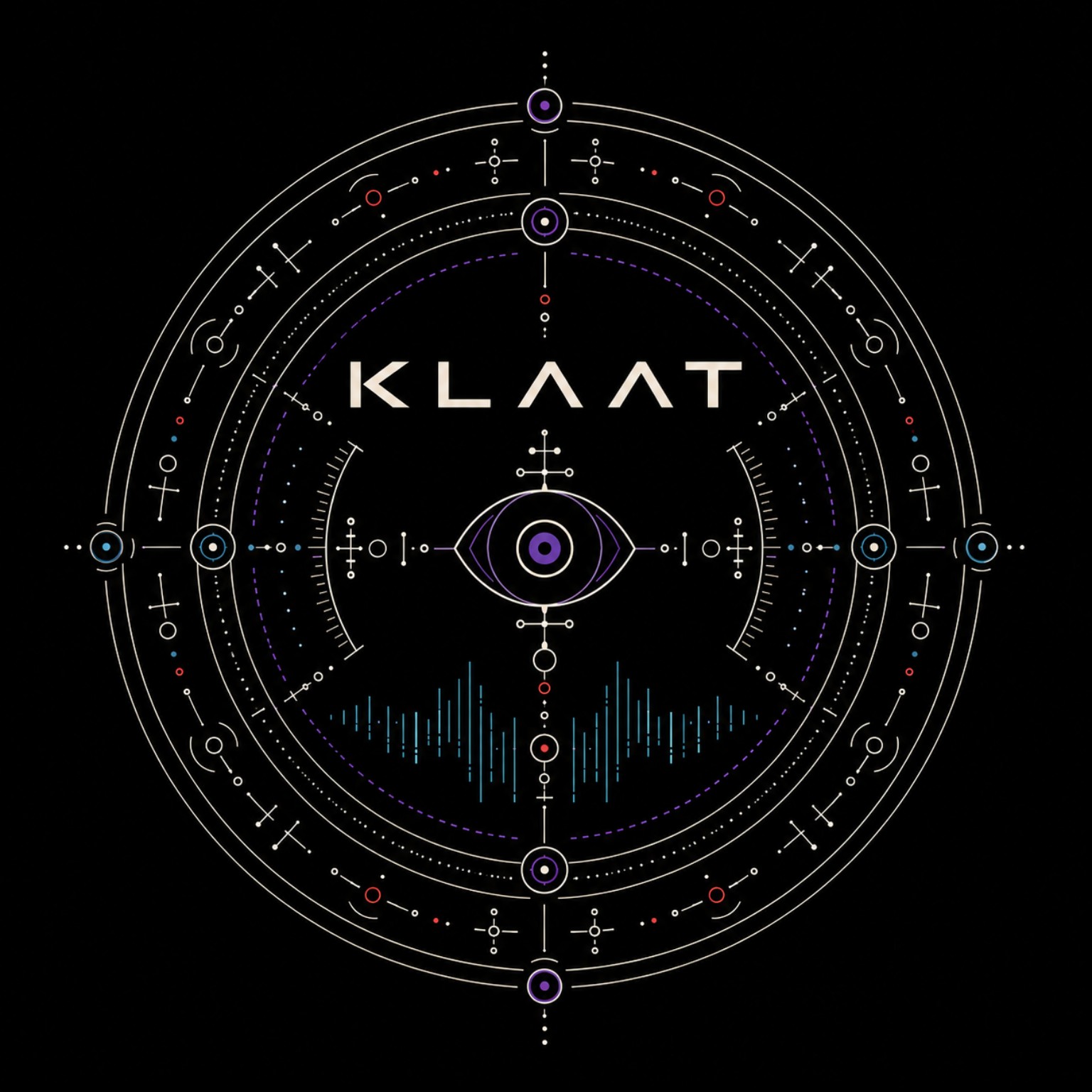
I've been exploring an archaeosonic style: diagrams and artifacts that look as though they might describe some forgotten system of resonance. It's mysterious without being generic fantasy or occult decoration.
Recordings, performances, artwork, jewelry, and other objects can all inhabit this same world. They don't have to look or sound identical; they should share a recognizable sensibility.
Still discovering what it becomes.
I want to keep practicing, recording, and producing long-form performances that are free to unfold naturally. I'm interested in live, immersive experiences as well as music that can accompany ordinary life.
KLAAT is bigger than a musical release or a stage performance. It's become an important part of how I see myself creatively, bringing together interests and an aesthetic I've been carrying for a long time.
I don't need to know its finished form. The discovery is part of the point.
KLAAT is an instinctive exploration of rhythm and resonance—driven by personal experience, investigated through science, and expressed through an evolving world of sound and art.